
Context Sans
What’s not written down.

In Excession, Iain Banks gave a name to the kind of problem a civilization meets exactly once. He called it an Outside Context Problem. The example he reached for was a tribe living happily on its island until the day the tall ships round the headland, or the Aztecs the morning Cortés walks ashore. The problem isn’t hard. It’s outside the frame entirely. You can’t register it as a problem until it’s already shaping you.
An Outside Context Problem was the sort of thing most civilizations encountered just once, and which they tended to encounter rather in the same way a sentence encountered a full stop.
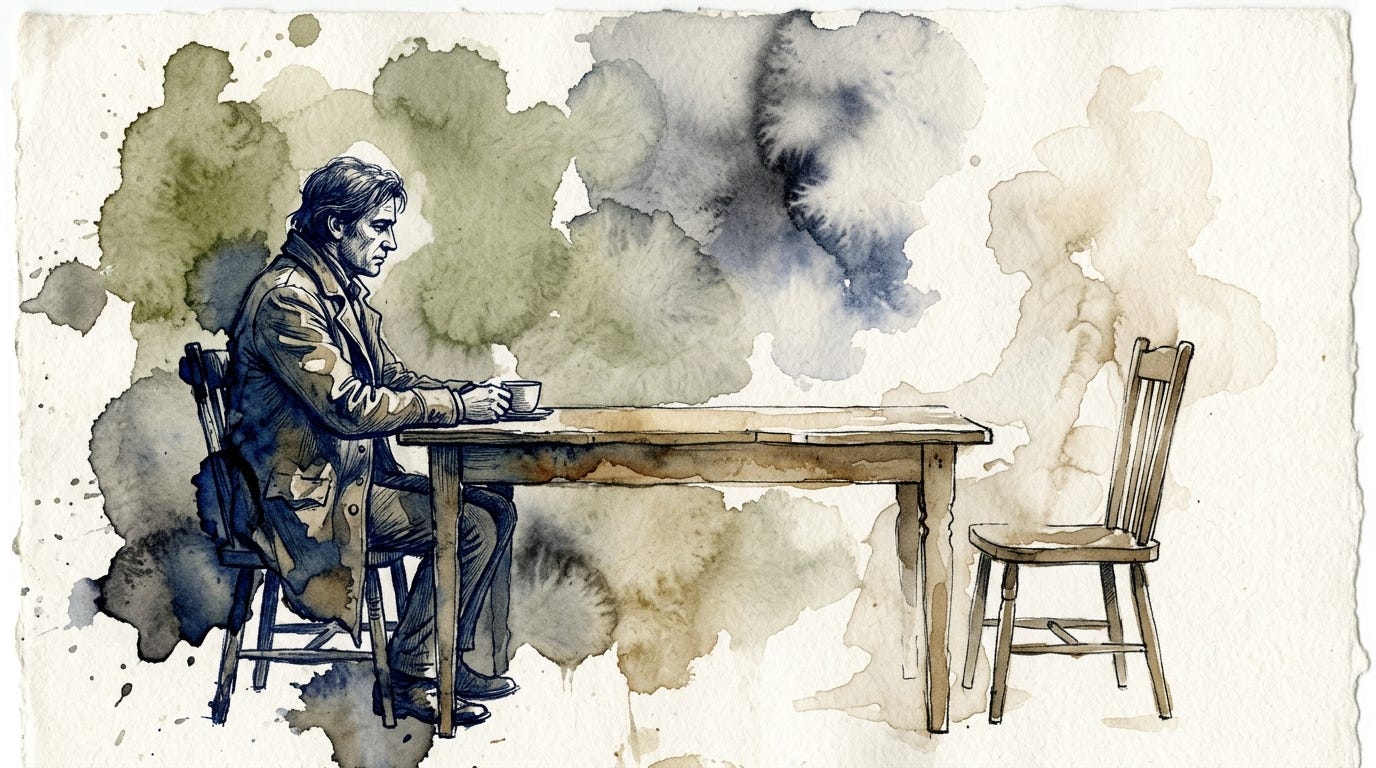
Civilizations meet one OCP in their history, if they’re unlucky. Agents are dropped into companies built out of them. The OCPs don’t read like aliens; they read like absences. A senior person’s instinct after eleven years on the account. A manual fix between two systems that nobody documented because nobody had to. A workflow whose consumer left two reorgs ago. None of that exists in the agent’s universe, and the agent has no protocol for noticing what isn’t there.
Every time I’ve started an implementation, the first week looks the same. Someone wants an agent for X, and we spend it finding out nobody has X written down anywhere a machine can read. The harder discovery is the next one. Ask three people how X works, get three different answers, all delivered with confidence. The SOP isn’t missing because nobody got around to it. It’s missing because nobody is aligned on it.
The SOPs nobody can produce
Push hard enough and you can usually get a senior person to write the SOP. The problem is the next senior person writes a different one, and they’ll defend it just as hard. Nobody is canonical, so nothing is canonical.
Humans handle this. They route around the disagreement. They call Maria when something is weird. The system runs because the misalignment never has to be resolved.
Agents can’t. They read what’s there and execute. If what’s there is wrong, they execute wrong. If what’s there is silence, they hallucinate. There is no “call Maria when it’s weird” path because Maria isn’t in their universe.
The fix isn’t writing the SOP. It’s having the meeting that resolves it.
Systems of record glued together by humans
Operations companies run on a stack of systems of record. Four is the floor. Twelve is the honest number once you count the spreadsheets someone owns. They don’t talk to each other.
The integration is the people. Someone copies IDs between systems. Someone exports CSVs every Friday. Someone knows that when CRM and billing disagree, billing wins, except for enterprise, which is different, except on Tuesdays when the timezones come in wrong and have to be fixed by hand.
That glue layer is invisible. It looks like people doing their jobs. It’s how the company actually runs, and the agent can’t see it. It can read the CRM. It can read tickets. It cannot read Sarah.
There’s one more thing the agent can’t see. Which workflows still have consumers. Bain has a name for it, organizational drag, time wasted on work no one will ever care about. Reports nobody opens. Decisions nobody acts on. Processes whose consumers left two reorgs ago, while the workflow stayed. The temptation is to agentify these. Resist it; you’d be paying to automate work that should be deleted.
What an agent inherits
This is what an agent inherits when leadership mandates “agentify the business.” Undocumented SOPs that two people would describe differently anyway. Fragmented systems. A glue layer made of people. Workflows that may or may not be alive.
This is what the corporate AI mandate skips. The technical condition the company is actually in.
What the context layer actually needs to be
The bar is lower than the platform pitches suggest. Companies hear “context layer” and reach for ontologies, knowledge graphs, schema registries. The bar isn’t perfectly structured. It’s knowable and reachable. A messy markdown file in a git repo beats a beautifully-modeled ontology that doesn’t exist yet. Knowable beats structured. Existing beats clean. Clean it up later, once the agent’s failure modes tell you which parts of the messy version were actually doing the work.
The agent doesn’t need to crawl your company. It needs named tools that hit known places. “Look up customer X in the CRM.” “Read the SOP for refunds.” “Pull the last seven days of tickets for product Y.” Each encodes a known pathway. The pathway is the contract. The pathway is the context. This is why the harness matters more than the model. Without named pathways, “agentify the business” means let an LLM guess. With them, it means give the agent the same map your senior people use, in machine-readable form.
The cheapest version is to just start. Most companies don’t have a context layer because they never began one. When the senior person answers a question, write the answer down once, in a place agents can read. Decisions get a paragraph. Processes get a list of steps. It’s a habit, not a platform. Six months of capturing produces more agentifiable surface area than a year of AI strategy.
Pick one workflow. Ask who reads its output. If you can’t name them, that’s the work. The AI part comes later.